
What are VNX+ Ethernet Switches? An Insight Into VITA-90 Rugged Networking System
Tuesday | May 26, 2026
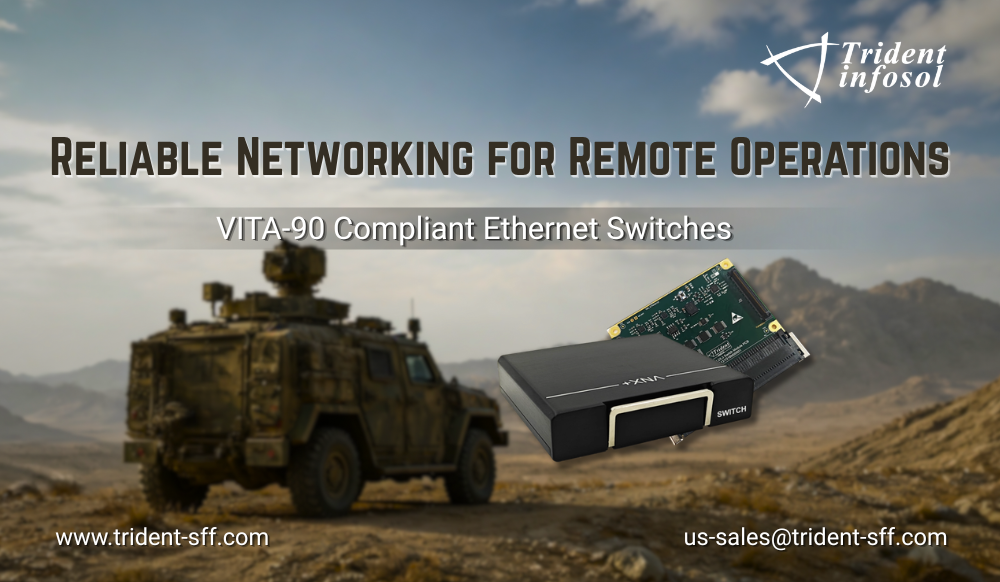
Embedded networking platforms used in aerospace, defense, industrial automation, and space applications face a unique challenge: they must deliver high-speed, reliable communication between electronic systems in environments where size, weight, and power (SWaP), are tightly constrained. Standard commercial networking gear simply isn't designed for this. So, as mission-critical systems grow more data-intensive, the demand for compact, high-throughput, and standards-compliant networking hardware has never been higher. This blog explains what makes the VNX+ Ethernet Switch architecture an essential technology for modern rugged deployments.
What Is a VNX+ Ethernet Switch?
A VNX+ Ethernet Switch is a managed Layer 2/Layer 3 switch module built specifically for these embedded, size-constrained VNX+ deployments. Unlike commercial switches, it integrates directly into a compact form-factor (VITA 90) system, routing all I/O and power through a standardized high-density connector interface. The result is a rugged switch that fits into mission-critical platforms without compromising on networking capability.
By combining Layer 2 & Layer 3 routing, and precision timing into a single VNX+ module, engineers can design more capable systems with fewer discrete components and reduce integration complexity.
Understanding the VITA 90 Standard and Why Compliance Matters
Any serious discussion of embedded networking modules must include the VITA family of standards, which defines mechanical and electrical specifications that allow modules from different vendors to interoperate within the same system.
A VITA-90 Compliant Ethernet Switch adheres to the ANSI VITA 90.0 specification, the VNX+ Base Standard which governs how I/O signals and power are routed through a 400-pin SEARAY™ connector. This standardization is critical for two reasons:
Interoperability Across Vendors
When a VNX+ switch module conforms to an open standard, system integrators are not locked into a single-vendor ecosystem.
Predictable Signal Integrity
The 400-pin connector architecture ensures that all I/O signals travel over a defined, validated interface.
Layer 2 and Layer 3 Capabilities: What the Switch Actually Does
A managed switch supporting both Layer 2 and Layer 3 operation is a substantially more capable device than a simple unmanaged switch.
Ethernet Switch Layer 2+ Software Support Includes
Traffic Management
Layer 2+ operation also includes multicast and broadcast storm control, flooding control, and flexible link aggregation using information from Layer 2 through Layer 4. Rapid Spanning Tree Protocol (RSTP) and MSTP ensure loop-free topologies, while multi-protocol support spans IEEE 802.1d, IEEE 802.1w, IEEE 802.1s, and IEEE 802.1x.
Layer 3+ Software Support Includes
Hardware and software-based IPv6 L3 static routing, RFC 2328 OSPFv2 dynamic routing, IEEE 1588 Precision Time Protocol (PTP), RADIUS accounting and port and queue policers.
Thermal Management Considerations
Port Configuration
The module provides 8 GigE ports via MDIO, two 10GbE SFI ports available either through the 400-pin connector with zero-aperture or via MT optical interfaces with a 320-pin half-aperture connector, along with a single RS232 console.
Scalable Port Expansion
Three QSGMII ports for 8, 12-port expansion with optional expansion module.
Power Envelope
The module operates on +3.3 Vdc and +5 Vdc inputs, consuming between 15 and 20 watts, consistent with what is available on most embedded computing backplanes.
Conclusion
In summary, the combination of rugged build, standards compliance, multi-layer networking capability, and compact dimensions makes the VNX+ switch architecture suitable for mission-critical applications in environments where standard commercial networking hardware cannot meet the environmental, SWaP or reliability requirements.
Explore Rugged Networking Solutions with Trident SFF
Trident SFF specializes in compact, high-performance embedded computing and networking modules for demanding environments. Contact us to discuss your requirements: +1 505-503-7491 | us-sales@trident-sff.com