
What is a VNX+ Test Platform? A Complete Guide to Benchtop Testing for VITA 90 Systems
Tuesday | March 24, 2026
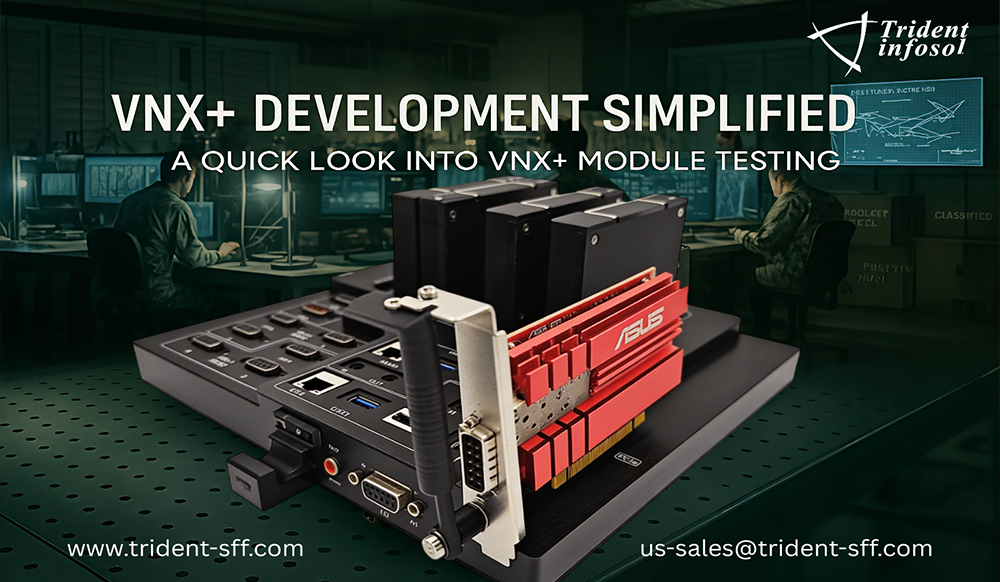
As embedded computing systems grow more powerful and architecturally complex, validating their performance before deployment becomes critical. For developers and system integrators working with the VNX+ ecosystem, a structured lab test environment is a prerequisite for reliable product development and qualification. This blog explains what a VITA 90 test platform is, how it fits into the development workflow, and what capabilities engineers should look for when evaluating a system or a module.
What is the VNX+?
VNX+ is a small form factor embedded computing standard governed by the VITA 90 family of specifications. It defines the mechanical, electrical, and interface characteristics for a range of module types—including single board computers (SBCs), GPU processing boards, power supply units (PSUs), and power filter boards, complying with VITA 90 as the base standard.
What is a VITA 90 Test Platform?
A VITA 90 test platform is a lab benchtop system designed to evaluate, develop, and test VNX+ modules. Its primary purpose is to give engineers a controlled environment where modules can be individually stress-tested before being integrated into a final system design. A dedicated test platform, like the VNX+ Lab Test Bench TJ3 provides the necessary infrastructure to bring up and validate modules efficiently.
Core Functions of a VNX+ Test Platform
A well-designed test environment for VNX+ modules performs several functions central to the development process:
Module Hosting
It provides physical slots conforming to the VNX+ 19mm profile, accommodating SBC, GPU, PSU and filter modules simultaneously.
Power Management
It supports both native VNX+ power subsystems and alternative sources such as a standard ATX connector or external SMPS PSU — ensuring development can continue even when dedicated VNX+ PSU modules are unavailable.
I/O Accessibility
All module I/Os are routed to inudstrial connectors, enabling engineers to interface with external modules.
PCIe Interfacing
PCIe lanes from SBC modules can be routed to a PCIe MUX device, enabling integration testing with external peripherals or modules.
Storage Provision
Provision for mSATA SSD modules allows operating systems to be loaded directly onto the test bench, enabling complete testing.
Power Architecture Flexibility
One of the distinguishing characteristics of a capable VNX+ test platform is its flexibility in power input. Since VNX+ module development often occurs in phases, the test platform must support fallback power options.
Typical power input options include a DC power jack and an ATX connector. Bypass jumpers allow engineers to route raw input power directly to the VNX+ PSU, or to bypass both the filter and PSU modules entirely if external SMPS-derived outputs are preferred. This approach ensures the platform remains usable across all stages of development.
PCIe Communication and MUX Architecture
In systems with multiple SBC modules, PCIe lane communication becomes important. A test platform that incorporates a PCIe MUX device allows engineers to select which SBC's PCIe lanes are active at a given time. By toggling a MUX select control signal, PCIe lanes from either SBC-1 or SBC-2 can be routed to a shared PCIe expansion connector, ensuring that only one SBC is connected to the PCIe expansion interface at any moment.
Thermal Management Considerations
VNX+ modules operating under sustained workloads generate significant heat. A test platform intended for performance evaluation should support active cooling—typically through an optional fan assembly—to maintain thermal stability during extended test runs. Adequate airflow not only protects the modules under test but also ensures that performance benchmarks are not skewed by thermal issues.
Conclusion
In conclusion, a VITA 90 test platform is an essential tool for any team working within the VNX+ ecosystem. By providing flexible power options, full I/O access, PCIe expansion capability, and multi-module hosting, it dramatically reduces the time and risk associated with embedded system development. As VNX+ adoption grows, having a purpose-built test environment becomes not just beneficia —but foundational to development success.
Trident SFF offers purpose-built solutions for VNX+ module development and validation
Contact us to learn how we can support your VITA 90 development program.
Reach us at: +1 505-503-7491 | us-sales@trident-sff.com |
www.trident-sff.com